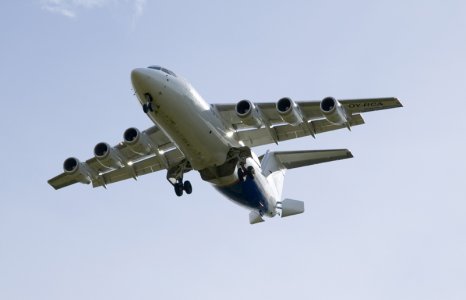
The reason for 4 engines was a combination of required power and the desire to have as quiet an airplane as possible. Early in its career, engine failures were a real problem; which resulted in the statement that it had 4 engines so it would always have a spare handy. The engines were originally developed by Lycoming in Bridgeport, CT before they were swallowed up in the merger craze.
[....]
No, the reason is indeed noise abatement. 4 low-power ultrahigh-bypass turbofans make a lot less noise than 2 higher power high-bypass turbofans (remember this was 20 years ago, it is now possible to make a twin with about the same noiselevel in that class).
Climb performance was also an important factor. In normal service, the aircraft does not need full power to climb, but the 4 engines give it power for steep climbs from short runways (London City comes to mind, but this was originally intended for military use from unprepared strips in combat zones. The 146 was envisioned as a light tactical transport for the RAF).
[....]
I was told the wing of the 146 didn't have the hardpoints that could support the weight of 2 larger engines, so they went with 4 smaller.
It was in the 70s when it was first designed, that there were no suitable engines of which the 146 could have one of each on its wings. the RR Spey and Jr. Spey were far too heavy for the 146s wings to hold, so they opted for four smaller engines instead.
[...]
The genesis of the 146 was not military, or related to carrying V.I.P.s.
In the early 70's, it was thought they'd be a boom in city centre airports, or more correctly 'STOLports'. To operate quiet, short take-off aircraft, the Dash 7 was also inspired by this idea.
In the early 70's, about the only possible powerplant was a fan adaptation of the powerplant fitted to CH-47 Chinook military helicopters.
The original HS-146 was axed in early 1974, due to the oil-crisis and big slump in civil aviation it caused.
As the BAe-146, the project was restarted in 1978.