Det var dengang. Nå finner du damer og barn i alle kabiner.
By Josh Wilson
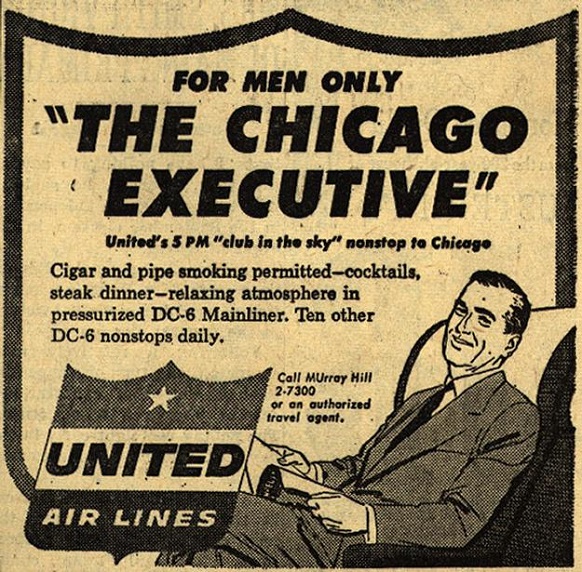
April 1953. United Airlines launched a new product on its New York to Chicago route. The flight departed at 5 p.m. on weekdays, flew on Douglas DC-6B Mainliners, and offered first-class seating, a full steak dinner, complimentary cigars, unlimited cocktails, slippers, closing stock market quotes delivered by teletype, and a gate-side service where agents would relay urgent business calls before pushback. A ticket cost $67, three dollars more than standard first class. The name was The Executive. The marketing copy was unambiguous: "A Club in the Sky, For Men Only." Women could not buy a ticket. Children were not allowed. The only women permitted on board were the flight attendants, who were required by unwritten rule to be young, unmarried, and attractive, and expected to notify the airline immediately upon engagement.
The service expanded to the West Coast, running a parallel route between Los Angeles and San Francisco. It operated six days a week. It racked up 10,500 total flight segments over 17 years. In its peak years it ran at 80 to 90 percent load factor. In January 1958, a woman named Edythe Rudolph Rein, a Vice President at National Telefilm Associates — tried to book the next United flight from Chicago to New York. The ticket agent told her it was the Executive Flight. She said: "I'm an executive." The agent did not budge. When a United spokesperson was asked to explain the policy in 1954, the response was: "What we give men is an opportunity to get away from women. We don't regard it as segregation. We regard it rather as a little luxury."
By the late 1960s load factors had collapsed to around 40 percent as social attitudes shifted and business travel demographics changed. In 1969, the National Organization for Women picketed United's Chicago headquarters and filed formal complaints with the Civil Aeronautics Board. United did not publicly credit the protests with ending the service. The airline cited declining demand. On January 14, 1970, the final Executive flight touched down. One passenger told The New York Times: "One of the nicer things in life is disappearing." A different era does not cover it.
#AviationHistory #UnitedAirlines #AviationStory #AviationFacts
By Josh Wilson
April 1953. United Airlines launched a new product on its New York to Chicago route. The flight departed at 5 p.m. on weekdays, flew on Douglas DC-6B Mainliners, and offered first-class seating, a full steak dinner, complimentary cigars, unlimited cocktails, slippers, closing stock market quotes delivered by teletype, and a gate-side service where agents would relay urgent business calls before pushback. A ticket cost $67, three dollars more than standard first class. The name was The Executive. The marketing copy was unambiguous: "A Club in the Sky, For Men Only." Women could not buy a ticket. Children were not allowed. The only women permitted on board were the flight attendants, who were required by unwritten rule to be young, unmarried, and attractive, and expected to notify the airline immediately upon engagement.
The service expanded to the West Coast, running a parallel route between Los Angeles and San Francisco. It operated six days a week. It racked up 10,500 total flight segments over 17 years. In its peak years it ran at 80 to 90 percent load factor. In January 1958, a woman named Edythe Rudolph Rein, a Vice President at National Telefilm Associates — tried to book the next United flight from Chicago to New York. The ticket agent told her it was the Executive Flight. She said: "I'm an executive." The agent did not budge. When a United spokesperson was asked to explain the policy in 1954, the response was: "What we give men is an opportunity to get away from women. We don't regard it as segregation. We regard it rather as a little luxury."
By the late 1960s load factors had collapsed to around 40 percent as social attitudes shifted and business travel demographics changed. In 1969, the National Organization for Women picketed United's Chicago headquarters and filed formal complaints with the Civil Aeronautics Board. United did not publicly credit the protests with ending the service. The airline cited declining demand. On January 14, 1970, the final Executive flight touched down. One passenger told The New York Times: "One of the nicer things in life is disappearing." A different era does not cover it.
#AviationHistory #UnitedAirlines #AviationStory #AviationFacts

 er er en lenke med noen bilder og reklameplakter